
Implementation Effort
- Requires minimal effort
- Timeline between 2-3 weeks*
* Assuming an agency has an existing, configured AASHTOWare Safety instance and all required data

Our Customer Success team helps agencies turn crash data into actionable insights. The processes below show how they’re making their communities safer.
The Idaho Transportation Department uses custom Dashboards in AASHTOWare Safety to improve the grant-request process for local safety planners statewide, making it easier to submit data-driven grant requests.
* Assuming an agency has an existing, configured AASHTOWare Safety instance and all required data


The Idaho Transportation Department Office of Highway Safety (ITDOHS) receives federal funding from the National Highway Traffic Safety Administration (NHTSA) to improve traffic safety in Idaho. These funds are distributed through a grant process, where identifying problems and engaging with the community are key components of a successful application.
AASHTOWare Safety partnered with ITDOHS to create the Idaho Crash Summary Dashboards and accompanying tutorial video to empower local grantees to pull precise data to support their requests. To help ensure funds are directed to areas of greatest need, the department encourages the use of crash data to craft compelling, specific, and accurate problem or need statements in grant proposals. This data-driven approach helps local entities across the state better identify safety issues, prioritize needs, and justify funding requests.
“Locals know their communities best. We want this grant money to go to community organizations that will impact traffic safety in their neighborhoods most.”
– ITDOHS Highway Safety Manager Josephine Middleton
The Idaho Crash Data Dashboards are open to the public and include dashboards focused on the following emphasis areas:
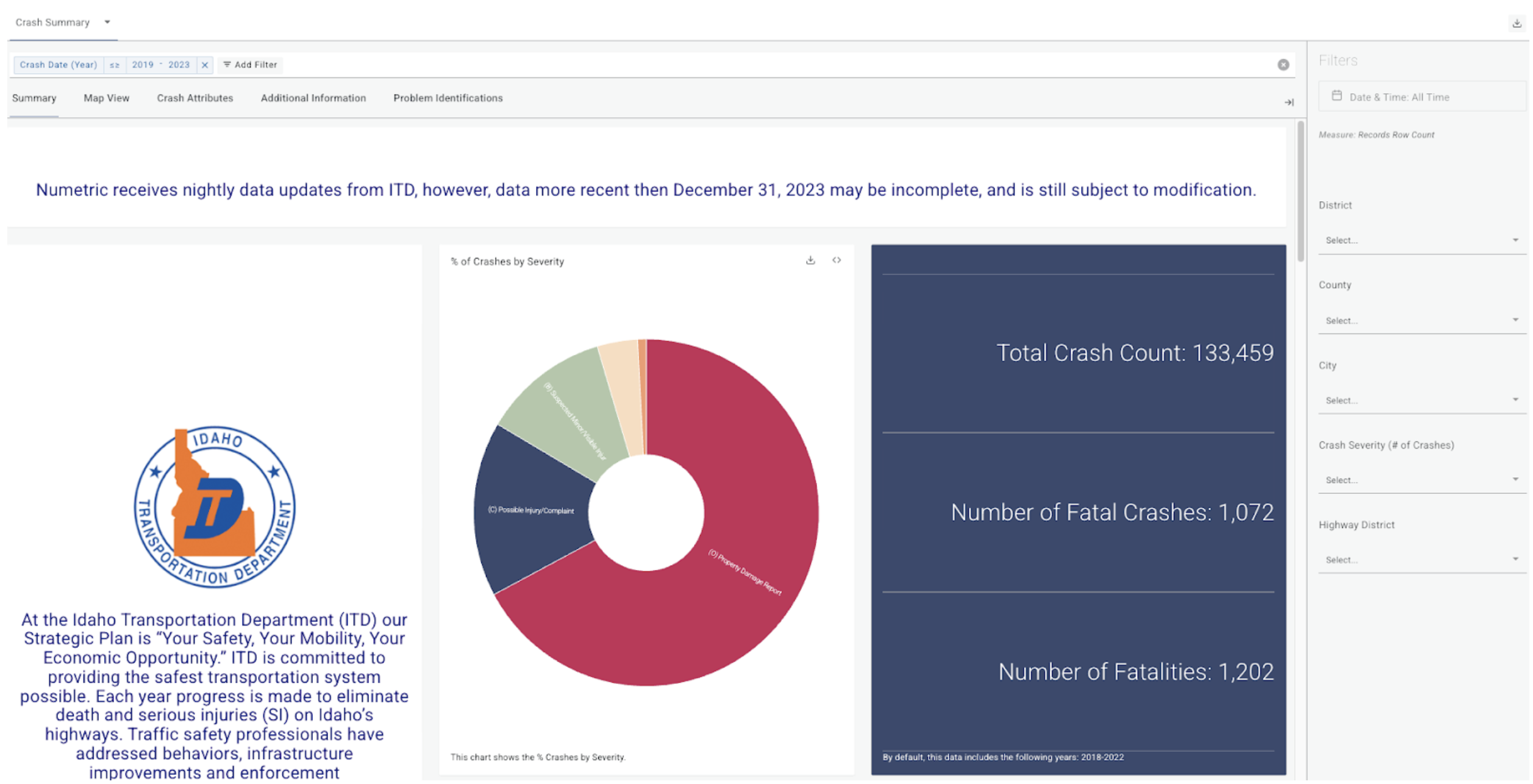
“Problem” or “Needs” statements are critical to every grant application. Not including a compelling problem statement can mean local safety planners might not receive the grant approvals and funds they’re seeking to improve safety in their area. Without data-backed assertions, it’s challenging to create a problem statement that captures the issue and explains in detail what problem the requested funds are needed for.
For example, rather than writing:
Aggressive driving is a significant issue contributing to crashes in the city of Idaho Falls.
Applicants can use the dashboard to provide details and backup claims with data:
The city of Idaho Falls experienced 4,367 crashes between 2019 and 2023, with the top problem identification attribute being aggressive driving-related. There were 2,605 aggressive driving-related crashes in the same time period, and 37% of all fatal crashes in the city involved an aggressive driver. Aggressive driver crashes account for .69% of fatal crashes, 3.15% of suspected serious injury crashes, and 61.19% of all possible injury/complaint crashes in the city.
Now, instead of being vague and unclear, anyone requesting grants across the state can use crash data to accurately illustrate the size and scope of the problem in their area. They can also use this information to write a detailed problem statement for their grant proposals.
Additionally, applicants are required to develop a Community Outreach, Education, and Engagement Plan. Applicants are encouraged to outline a list of proposed events and initiatives that will inform and involve the public in traffic safety efforts.
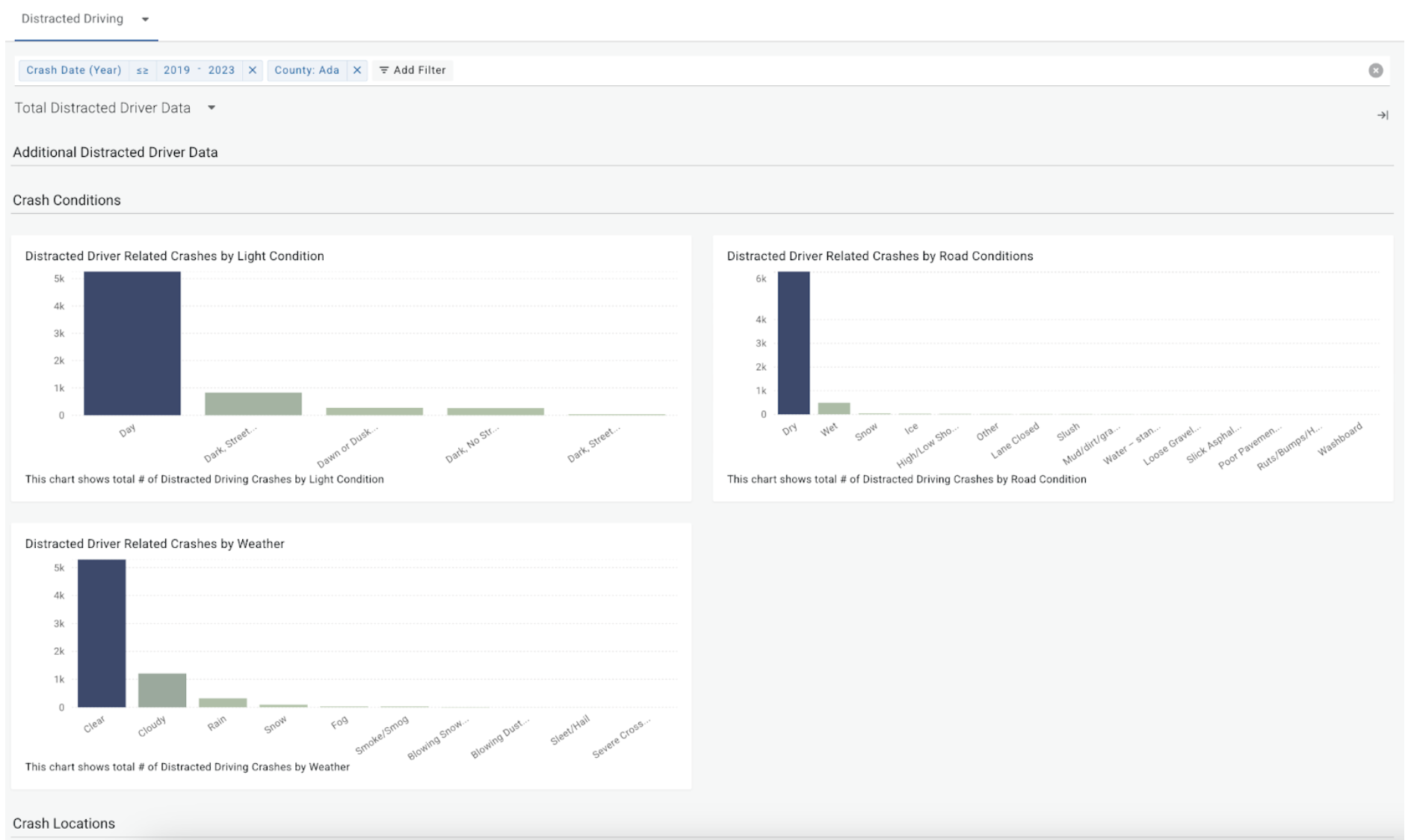
The dashboard supports these efforts by providing easily accessible, visual crash and safety data that can be downloaded and shared on social media, in presentations, on flyers, and at community events.
By providing access to transparent, easy-to-use crash data dashboards, the Idaho Transportation Department is enhancing the ability of local safety planners and law enforcement to develop well-informed, impactful grant applications. This data-driven approach ensures that safety funds are directed to where they are needed most, supporting Idaho’s commitment to reducing traffic crashes and roadway fatalities across the state.
More information on this topic can be found below: